Vaše hlášení o transparentnosti, svobodě tisku nebo korporátním a politickém vlivu pomáhá zajistit spravedlivý právní systém a rovnost pro všechny před zákonem.
Detail článku
The Baťa Gold: How Britain and Canada Seized Jan Antonín Baťa’s Wartime Reserves—and Redirected His Empire
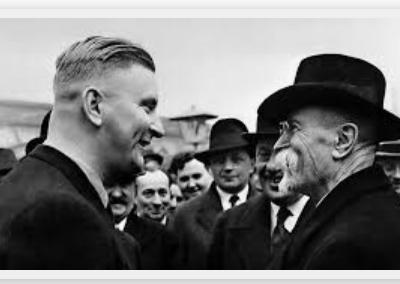
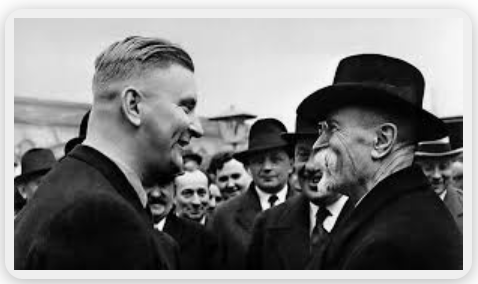
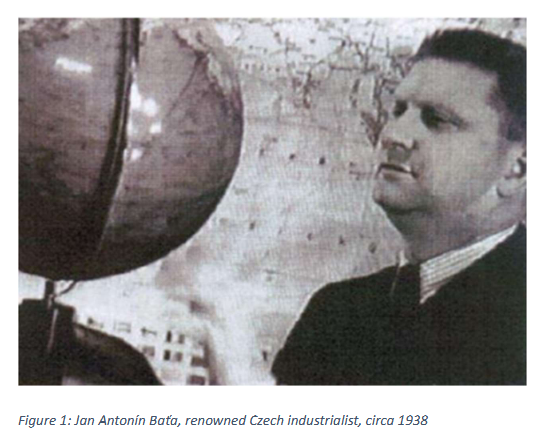
Baťa was a "fighter", determined to preserve his business and his people regardless of British misunderstanding or hostility. He was the opponent of the Munich capitulation. His opinion was that the country should have fought.
Za informace uvedené na této stránce nese plnou odpovědnost autor textu. European Justice Organization z.s. poskytuje pouze publikační účet pro nezávislé novináře a nenese odpovědnost za obsah ani za uvedené zdroje.
Abstract: This article examines the wartime seizure and immobilization of Jan Antonín Baťa’s gold reserves in Canada and British India, revealing how Allied custodianship functioned not merely as economic regulation but as an instrument of imperial control and corporate dispossession. Intended as a strategic reconstruction treasury for postwar Zlín and Czech industry, Baťa’s gold became the focal point of a British-sponsored campaign of blacklisting, financial coercion, and intelligence pressure designed to constrain Baťa’s independence. Although British and Allied authorities fully understood that Jan Antonín Baťa was the legitimate legal head and owner of the global Baťa enterprise, this fact was deliberately disregarded as control was redirected to Thomas J. Baťa Jr., a younger and more politically manageable figure, for the duration of the war. Drawing on Glenn W. McPherson’s unpublished manuscript, custodial memoranda, and postwar diplomatic dispatches admitting that authorities “never established anything against” Baťa, the article reframes the case as a striking inversion of justice: a Czech industrial leader treated as guilty until proven innocent, and national resources intended for recovery absorbed into Allied wartime systems. For Czech and Slovak audiences, the Baťa gold affair resonates as a powerful historical correction and moral reckoning—exposing how even Allied powers participated in the erosion of Czech industrial sovereignty through suspicion, propaganda, and the quiet machinery of enemy property law.
By John G. Nash
Feb. 4, 2026 *** In the early months of the Second World War, Jan Antonín Baťa quietly placed a portion of his company’s most vital reserves beyond the reach of catastrophe. Gold—real, liquid, portable wealth—was deposited in Canada, held through obscure corporate structures and trusted intermediaries, intended not for speculation or escape, but for a single purpose: the postwar reconstruction of the Baťa enterprise in Czechoslovakia.
Baťa understood what few industrialists of the era were willing to admit openly: Europe was collapsing, borders were meaningless, and governments—whether Nazi or Allied—would seize whatever they could justify in the name of war.
For Jan Baťa, gold was insurance. A reserve for rebuilding Zlín, restoring Czech industry, and safeguarding the livelihoods of tens of thousands of workers after the war ended.
But instead of serving as a lifeline for reconstruction, Baťa’s gold became the centerpiece of something else entirely: a British-sponsored custodial operation that immobilized his wealth, blacklisted his global enterprises, and ultimately helped redirect control of the Baťa empire away from its legal president—toward a far younger and politically pliable figure: Thomas J. Baťa Jr.
What unfolded in Canada and British India was not merely wartime regulation. It was an imperial confiscation campaign, conducted in secrecy, justified through smears, and carried out under the machinery of Enemy Property law.
A Reserve Trapped in Canada
Among the most significant wartime Baťa reserves was a Canadian deposit linked to a small shell company known as Muscamo, formally capitalized at only $500.
Yet inside this tiny entity rested an extraordinary immobilized reserve:
“Of course there was a 1,700,000.—$ loan in this Company, the reserves, that could not be moved from Canada.”
This was not ordinary cash. The reserve could not be transferred precisely because it was held in gold, beyond routine wartime banking mobility.
At the fixed 1939–1940 exchange rate (C$1.10 = US$1.00), Baťa’s C$1.7 million represented approximately US$1.55 million, equivalent to roughly 44,200 troy ounces, or 1.375 metric tons of gold.
In today’s terms, at approximately US$5,500 per ounce, Jan Baťa’s Canadian wartime reserve would be worth nearly:
US$243 million
This was not a marginal emergency fund. It was a strategic reconstruction treasury, frozen in place.
And Canadian authorities wanted it.
The Custodian Moves In
The mechanism of seizure was the Custodian of Enemy Property, an office theoretically designed to safeguard assets connected to enemy-occupied territories.
But as Glenn W. McPherson’s unpublished manuscript makes unmistakably clear, the Custodian’s role quickly expanded beyond safekeeping into political and corporate control.
After the German occupation of Czechoslovakia, Baťa’s Canadian enterprise at Batawa was vested under Custodian authority because it was legally tied to an occupied country:
“…the Bata plant was owned by the people in occupied Czechoslovakia territory… therefore considered an enemy plant and was taken over by the Custodian.”
A “special committee” was appointed to oversee operations throughout the war.
Although Tomáš Baťa Jr. remained the visible manager, vesting implicitly acknowledged what McPherson’s memoir tried to obscure: Jan Antonín Baťa was the legal head and owner of the global organization.
An Elevated Manager Under McPherson’s Authority
McPherson repeatedly framed Thomas Jr.—then only 27 years old—as the rightful heir and cooperative face of the Baťa enterprise.
Officials in C.D. Howe’s department, he recalled, decided Thomas was too “valuable” to remain enlisted:
“Tommy Bata was too valuable to be allowed to be in the Army… he should remain in charge of the Bata plant…”
The Canadian state, in effect, needed Thomas in place: not as an owner, but as a controllable operator.
Batawa was no longer primarily a shoe factory. It was producing precision wartime materials, including gyroscopes for British torpedoes and other war materials.
Jan Baťa’s company infrastructure—and Jan Baťa’s trapped reserves—were being redirected toward Allied war production, through the public legitimacy of a young subordinate.
The Gold Becomes the Target
McPherson’s manuscript exposes the Custodian’s true obsession: Baťa’s gold.
He admitted that he and his Montreal agent, Guy Hoult, were focused “first of all” on the gold Baťa held in Canadian banks:
“We were interested in the gold that the Bata Company had in Canadian Banks…”
From there, McPherson’s account collapses into suspicion-driven fantasy: rumors of Nazi gold deposits, imagined sabotage networks, and insinuations untethered from evidence. He even claimed—absurdly—that Jan Antonín Baťa hunted with Hermann Göring. This allegation was demonstrably false. Göring was not Baťa’s associate but an ideological and practical enemy of the Czech industrial system Baťa had spent decades building.
That distortion stands in sharp contrast to testimony later given by Tomáš Baťa Jr. himself before a United States government committee on February 4th, 1942. Recalling an earlier detention by German authorities, Tomáš Jr. described the atmosphere of arbitrary suspicion surrounding the Baťa name: “They asked if we were Jews, and when we answered that we were not, the officials said, ‘Why not?’” He testified that he was held for six hours, while his uncle, Jan Antonín Baťa, was detained for twenty-four—an episode illustrative of the climate of presumption rather than proof.
More importantly, Tomáš Jr. offered unequivocal testimony regarding his uncle’s political stance. Speaking candidly, he stated: “Actually, Jan Baťa had been the staunchest enemy of the Munich surrender. His opinion was that the country ought to have fought.” This sworn statement directly contradicts McPherson’s later insinuations of political ambiguity or opportunism. Rather than a collaborator or fence-sitter, Jan Antonín Baťa emerges—by the testimony of the very man later elevated under Allied custodianship—as a principled opponent of capitulation and a consistent critic of both Nazi domination and appeasement politics.
McPherson also described an oil portrait in Baťa’s Baltimore home, stating he thought it was Tito—when in fact the prominent portrait was of Tomáš Baťa Sr., the founder of the enterprise.
Had McPherson been interested in understanding rather than smearing, he could have asked.
Instead, misidentification became insinuation.
Jan Antonín Baťa’s sealed letter, hand-delivered to Glenn McPherson after the meeting, stands as one of his most direct and defiant wartime statements. Rather than pleading for mercy or merely requesting removal from the blacklist, Baťa condemned the British Ministry of Economic Warfare’s decision as a catastrophic strategic mistake—“spilt milk”—caused by betrayal within the Baťa organization and driven by private opportunism. He argued that blacklisting him served Hitler’s interests by pushing one of Britain’s natural industrial allies toward isolation. Baťa insisted he was not a beggar seeking pardon but a “fighter” and “commander” of a Czech industrial front, determined to preserve his enterprise and his people regardless of British misunderstanding or hostility.
At its core, the letter demanded British protection and the controlled release of frozen Baťa funds for their original purpose: sustaining operations outside German reach and preserving resources for postwar Czech reconstruction. Baťa explained that secrecy in ownership arrangements was necessary to shield associates still in Zlín from deadly reprisals, and he framed his position as one of national duty rather than personal profit.
The meeting at Jan Antonín Baťa’s home was not initiated by Thomas Baťa Jr., but rather arose from Glenn McPherson’s own custodial and intelligence-driven agenda. Acting through the Canadian Custodian’s office and in coordination with British-linked agents such as Guy Hoult and Richard Coit , McPherson sought direct access to Baťa in order to pressure him into cooperation and to clarify the status of Baťa’s overseas assets—especially gold reserves and control of the global enterprise. The encounter was therefore less a family succession matter than a strategic intervention by Custodian authorities, reflecting McPherson’s broader effort to constrain Jan Baťa’s independence and redirect Baťa resources under Allied oversight.
[Richard Coit was a senior operative within William Stephenson’s British Security Coordination (BSC), serving in its Special Operations Section as both a recruiter and overseer of clandestine personnel. His duties centered on vetting agents, enforcing strict secrecy, and ensuring absolute loyalty to British intelligence objectives. Coit required recruits to sign the Official Secrets Act and to swear “blind and everlasting obedience,” making clear that BSC service demanded unquestioning compliance and total confidentiality. Known within the organization for his forceful temperament and role in propaganda and covert operations—particularly in Latin America and Brazil—Coit functioned as a key intelligence intermediary in wartime efforts that blended espionage, economic control, and strategic influence over foreign enterprises such as Baťa.]
[Glenn W. McPherson’s duties extended far beyond conventional custodianship and placed him directly within the covert intelligence structure overseen by William Stephenson, Britain’s top wartime spymaster in North America. Although publicly serving as a Canadian Custodian of Enemy Property official, McPherson described being recruited under conditions of strict secrecy through Richard Coit and British Security Coordination, required to sign a British oath of confidentiality and instructed to disclose nothing about his assignment or the organization directing it. In practice, McPherson functioned as a special assistant within Stephenson’s intelligence network, coordinating sensitive economic investigations, supplying information across British and Canadian security channels, and helping integrate custodial controls with wider Allied strategy.
Within this role, McPherson’s responsibilities included monitoring foreign-owned industrial assets, restricting financial movements—especially gold reserves—recruiting cooperation from multinational enterprises, and applying blacklisting and economic blockade as instruments of wartime pressure. His manuscript links him to Stephenson’s clandestine operations surrounding Camp X in Ontario, where agents were trained in sabotage and espionage, and to broader Allied intelligence coordination involving MI5, the RCMP, and covert recruitment pipelines through New York. McPherson’s activities in the Baťa case thus illustrate how the Custodian’s office operated not simply as an administrative safeguard, but as an intelligence-adjacent mechanism for economic containment, corporate restructuring, and imperial control over strategically valuable foreign enterprises.]
Glenn W. McPherson: Deputy Counsel to the Custodian of Enemy Property in Canada and also "Special Assistant" to William Stephenson. As documented in his personal papers, McPherson was actively recruiting trusted personnel for covert operations and described the plan to use "the Bata world organization for intelligence purposes."
The Montreal Vault Interception
The most dramatic episode in McPherson’s manuscript is the secret interception of Baťa-linked gold bars in Montreal.
McPherson describes receiving a call from Barclays Bank:
“We’d found a large cache of gold bars in Barclays Bank in Montreal, held under the name of a Swiss law firm…”
A Swiss lawyer arrived with instructions to release the gold and ship it to New York.
McPherson responded personally:
“I caught the first train to Montreal… met the Swiss lawyer in the bank manager’s office…”
The lawyer insisted the gold belonged to neutral Swiss interests.
McPherson invoked wartime regulations:
“…unless he could prove his statements there was no way he could get the gold out of Canada.”
The gold remained sealed in the vault.
McPherson later admitted the motive was not mere legality but coercion:
“We were determined to prevent Jan Bata from getting any financial assistance from any allied country unless he agreed to cooperate with us…”
This was economic warfare—gold as leverage.
Belcamp: Intelligence Demands and Blacklisting
In 1940–41, McPherson, Hoult, and Richard Coit (linked to British intelligence) traveled to Baťa’s American plant at Belcamp, Maryland.
Their mission was explicit: compel Jan Baťa to place his worldwide enterprise at the disposal of Allied intelligence.
McPherson later wrote:
“…asked him if the Company around the world would cooperate with Canada and with the British Intelligence…”
Jan refused.
McPherson framed this refusal as hostile intent, justifying blacklisting.
Yet the underlying logic was imperial: cooperation meant submission.
When Baťa declined to turn his industrial network into a British intelligence apparatus, the Custodian moved toward dispossession.
The Smoking Gun Memo: Britain Wants Jan Removed
The clearest evidence of intent appears in McPherson’s confidential Ottawa memorandum dated November 7, 1940, addressed to Dr. Coleman:
“The British feel that Dr. Bata… cannot re-establish his position… and they are anxious that he should withdraw, possibly to Brazil, and place Thomas Bata, Jr., in charge of the World Organization…”
This is not wartime protection. It is a plan of corporate replacement.
British authorities did not want Jan Baťa “on the fence.”
They wanted him removed.
And Thomas Jr. installed.
British India: The Second Confiscation
The same custodial machinery operated across the Empire.
In British India, Jan Baťa’s donated gold bars—offered to support the Czech government-in-exile—were rejected and confiscated by the Enemy Property Custodian.
Declassified Ministry of External Affairs records confirm that the donation did not become wartime support.
Instead, it became imperial property control.
The refusal could not have occurred without British approval.
The gold was immobilized—not to defeat Germany, but to prevent Baťa’s independent Czech resources from strengthening an autonomous postwar position.
A Corporate Takeover Under Wartime Law
McPherson concluded triumphantly that custodians “saved” the Baťa empire for Thomas Jr.
But the record reveals something different:
Jan Baťa’s gold was immobilized.
His enterprises were blacklisted.
Smears were circulated (Göring, Hitler’s friend).
Custodians demanded intelligence cooperation.
A young subordinate was elevated as the acceptable heir.
Assets were vested, redirected, and later handed over.
What was called “protection” was, in practice, control.
Under the language of wartime loyalty, the British-sponsored Custodian offices transformed emergency regulation into corporate seizure.
Jan Baťa’s reconstruction gold—worth nearly a quarter-billion dollars today—was not merely trapped.
It was weaponized.
And the Baťa empire was reshaped accordingly.
Jan Antonín Baťa was not destroyed by Nazi occupation of the Czech, Slovakia, or occupied Europe alone.
He was dismantled through Allied custodianship.
In Canada and British India, Enemy Property law became an instrument of imperial advantage: immobilizing wealth, enforcing compliance, and redistributing ownership.
The Baťa gold was meant to rebuild Bata’s Czechoslovakian enterprises after the war.
Instead, it financed wartime production under Allied control—and helped facilitate one of the most consequential corporate takeovers of the war.
Not by force of arms.
But by vault keys, blacklists, and custodians.
Summer of 1939, Guilty Until Proven Innocent
Months before war was declared —before Canada had even entered the war—Glenn W. McPherson was already designing the legal machinery to seize and immobilize targeted foreign assets, effectively setting Jan Antonín Baťa up for blacklisting in advance. Working through the King government’s War Committee, McPherson drafted what became the Trading With the Enemy Regulations, and he later admitted in his unpublished manuscript that his goal was not simply wartime administration but to gain control of property preemptively and shield these actions from postwar legal challenge. Crucially, this system inverted normal jurisprudence: instead of the presumption of innocence, custodial procedure operated on a wartime logic of guilty until proven innocent, requiring individuals like Baťa to demonstrate their loyalty and legitimacy after their assets had already been vested and frozen. In this light, Baťa’s later “negotiations” with the British Ministry of Economic Warfare in early 1940 appear less like genuine inquiry and more like a procedural façade for a conclusion already in place—Baťa would be treated as suspect, deprived of capital, and brought under custodial control unless he could prove otherwise.
Conclusion: Suspicion Without Proof
In the end, the most damning verdict on the wartime custodial campaign against Jan Antonín Baťa came not from Baťa himself, but from the very imperial apparatus that had pursued him. After years of blacklisting, gold seizures, intelligence pressure, and propaganda-laden accusations, the Custodian system was still unable to produce evidence of wrongdoing. A Secret air-courier dispatch from the Canadian Embassy in Rio de Janeiro—forwarded directly to the Custodian of Enemy Property and to External Affairs officials in Ottawa, including Lester B. Pearson—recorded the British Embassy’s blunt admission:
“This man was under suspicion during the War, but they have never been able to establish anything against him.”
The statement is devastating in its simplicity. The Baťa gold had been immobilized, Jan Baťa’s enterprises disrupted, and control redirected toward Thomas J. Baťa Jr., all under the presumption of threat. Yet when the war ended and the machinery of accusation was forced to account for itself, the Custodians had nothing—no proof of collaboration, no substantiated enemy dealings, only the residue of a campaign built on conjecture, coercion, and strategic convenience. The Baťa case thus stands as a stark illustration of how wartime economic regulation and imperial intelligence could operate on the logic of seizure first and justification later, leaving behind not evidence of guilt, but a record of dispossession without foundation.
In his unpublished manuscript, Glenn McPherson later contrasted the divergent wartime outcomes within the Baťa organization by noting that Tomáš Baťa Jr. and the branch of the company operating under Allied custodial protection went on to expand dramatically in the postwar period, instantly marketing a quarter-of-a-billion pairs of shoes annually under the new management. McPherson presented this success as evidence of the Custodian’s benevolent role, emphasizing that Baťa’s assets in Canada had been “stood guard over” until the end of the war—an interpretation that, in his telling, justified custodial control even as Jan Antonín Baťa’s gold reserves and independent enterprises remained immobilized, blacklisted, or redirected under Allied authority.
McPherson asserted that the Canadian Custodian’s treatment of Jan Antonín Baťa’s assets was not exceptional but part of a coordinated custodial regime operating across the British Empire. Under this system, custodians in Canada, British India, and other imperial jurisdictions imposed parallel measures on Baťa-related properties, immobilizing assets, restricting transfers of ownership, and denying independent control under the authority of wartime regulation. Within this same framework, General Edward L. Spears—director of Baťa’s pre-war interests in Great Britain—was discreetly appointed pro tempore chairman of Baťa enterprises within the British Empire, consolidating imperial oversight while effectively sidelining the organization’s legal head.
Archival Sources
1. McPherson, Glenn W. The Man from Undercover. Unpublished manuscript. Glenn McPherson Fonds (ARC-1368), University of British Columbia Rare Books and Special Collections, Vancouver, British Columbia; cited in Kay Alsop, The Man from Under Undercover: The Untold Story of Glenn McPherson, Intrepid’s Man in Canada.
2. Thomas J. Baťa with Sonja Sinclair, Bata: Shoemaker to the World (Toronto: Stoddart Publishing, 1990), 150.
3. Jan Antonín Baťa, Secret hand-delivered note to Glenn W. McPherson, 1940, sealed manuscript letter, referenced in Glenn W. McPherson, The Man from Undercover (unpublished manuscript).
4. Canada, Department of the Secretary of State, Office of the Custodian of Enemy Property, Confidential memorandum for Dr. Coleman regarding Bata Shoe Company of Canada Ltd., November 7, 1940, signed by Glenn W. McPherson.
5. E. Benjamin Rogers, Charge d’Affaires, Canadian Embassy, Rio de Janeiro, dispatch no. 77, April 10, 1947 (Secret), air courier to the Secretary of State for External Affairs and the Custodian of Enemy Property, Ottawa, May 14, 1947, reporting that British authorities “have never been able to establish anything against” Jan Antonín Baťa.
6. United States Government. Testimony of Tomáš Baťa Jr., hearing between representatives of the United States Government and the Bata Shoe Company, February 4, 1942.
7. British India. Ministry of External Affairs. List of Declassified Documents, 1903–1972. File 841, Progress No. 33-W (1941). Secret.
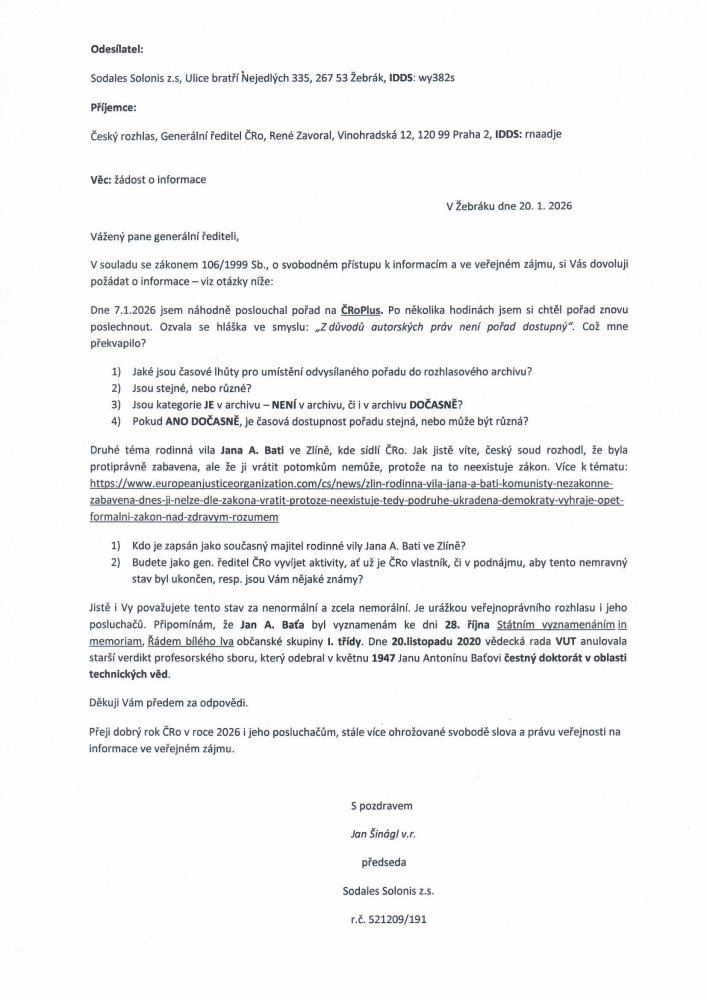
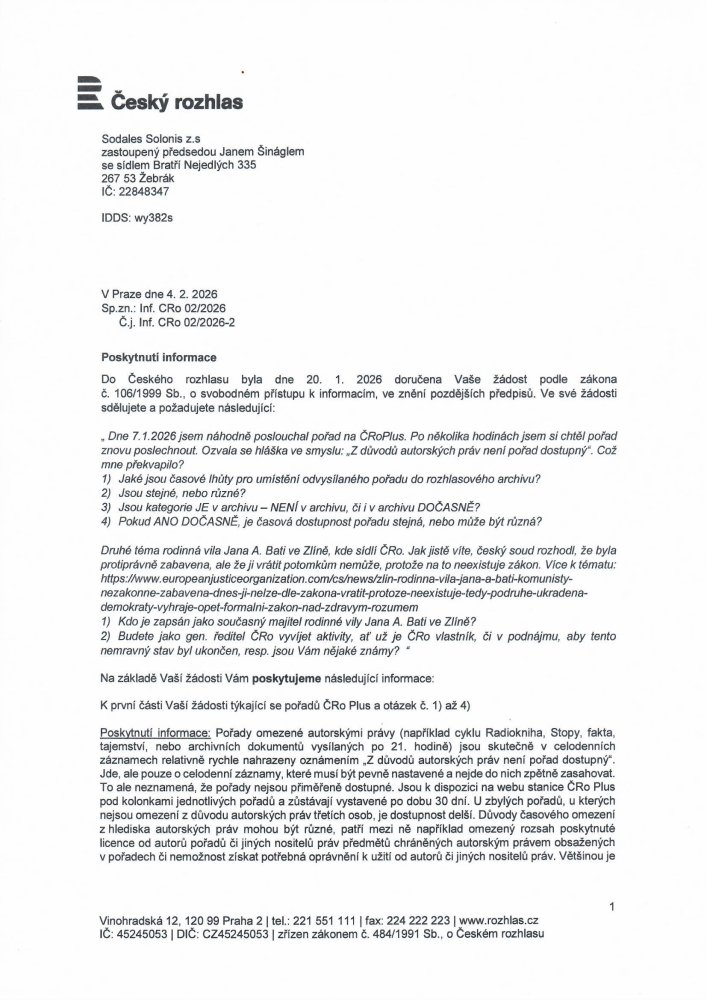
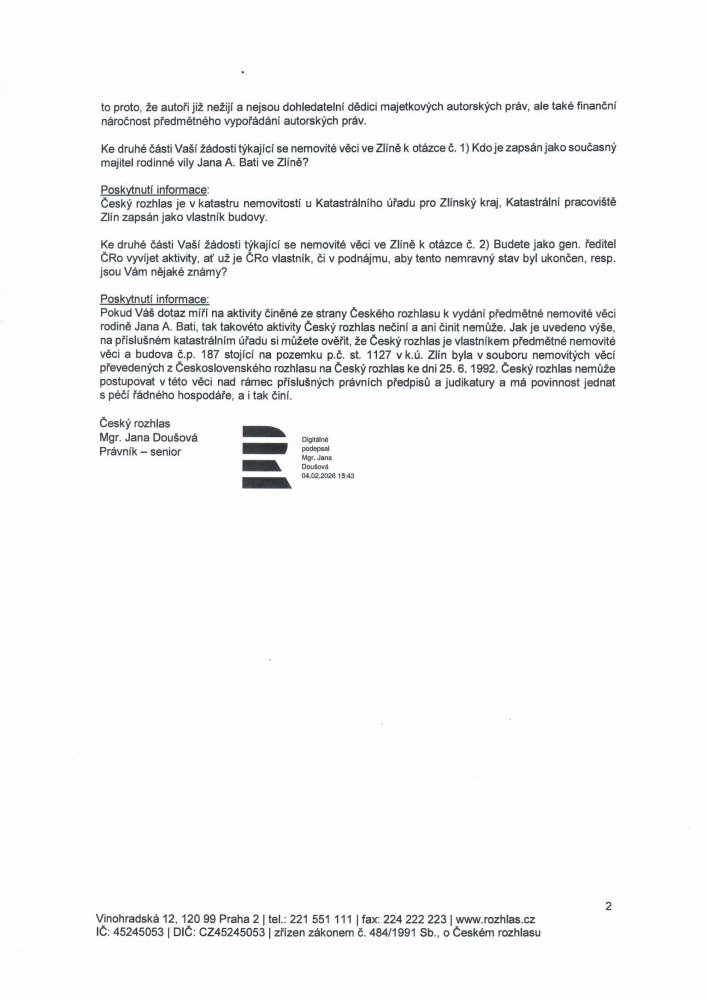
Version 2.0 *** P.S. Attached is a request for information addressed to René Zavoral, Director General of Czech Radio (January 20, 2026), and his response (February 4, 2026) regarding the family villa of Jan A. Baťa in Zlín. The villa was unlawfully confiscated, which was acknowledged by the court, but it cannot be returned because there is no law allowing it to be done so.
This is how we continue to destroy the true elites and their legacy, even after their death. We should not be surprised at the state of the country, which lacks elites and increasingly new Baťas, if it is to survive! JŠ
Podpořte nezávislé vyšetřování a sdílení pravdy
Každý Váš příspěvek nejen pomáhá financovat naši práci, ale také podporuje šíření těchto informací, aby se dostaly k co nejvíce lidem. Společně tak můžeme zajistit odpovědnost a spravedlnost, aby pravda nezůstala skrytá. Děkujeme za Vaši podporu!